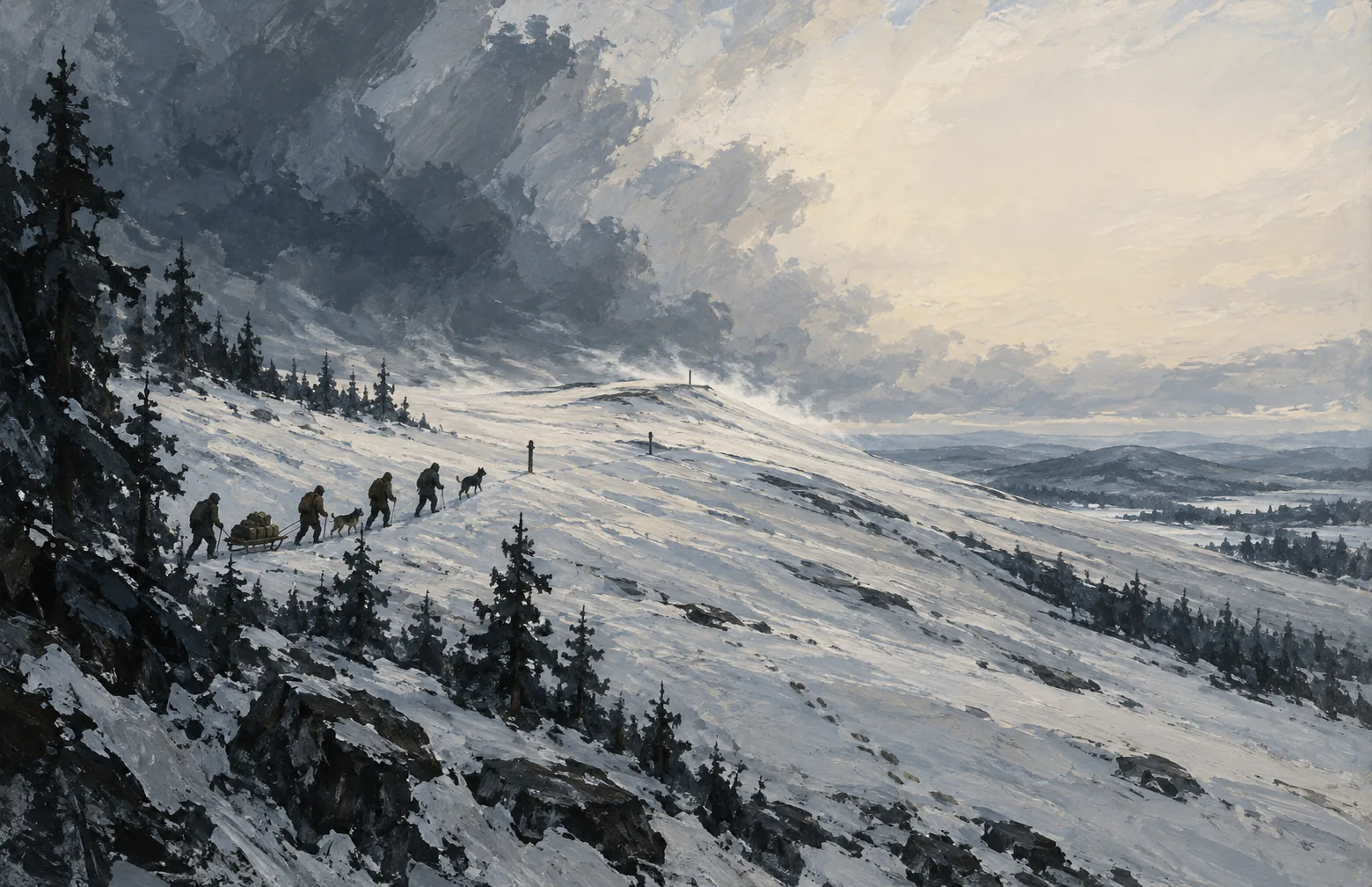
The count is the drama.
Food, dog feed and fuel are tracked in the open, in small honest numbers. Every kindness on the trail is paid for by someone.
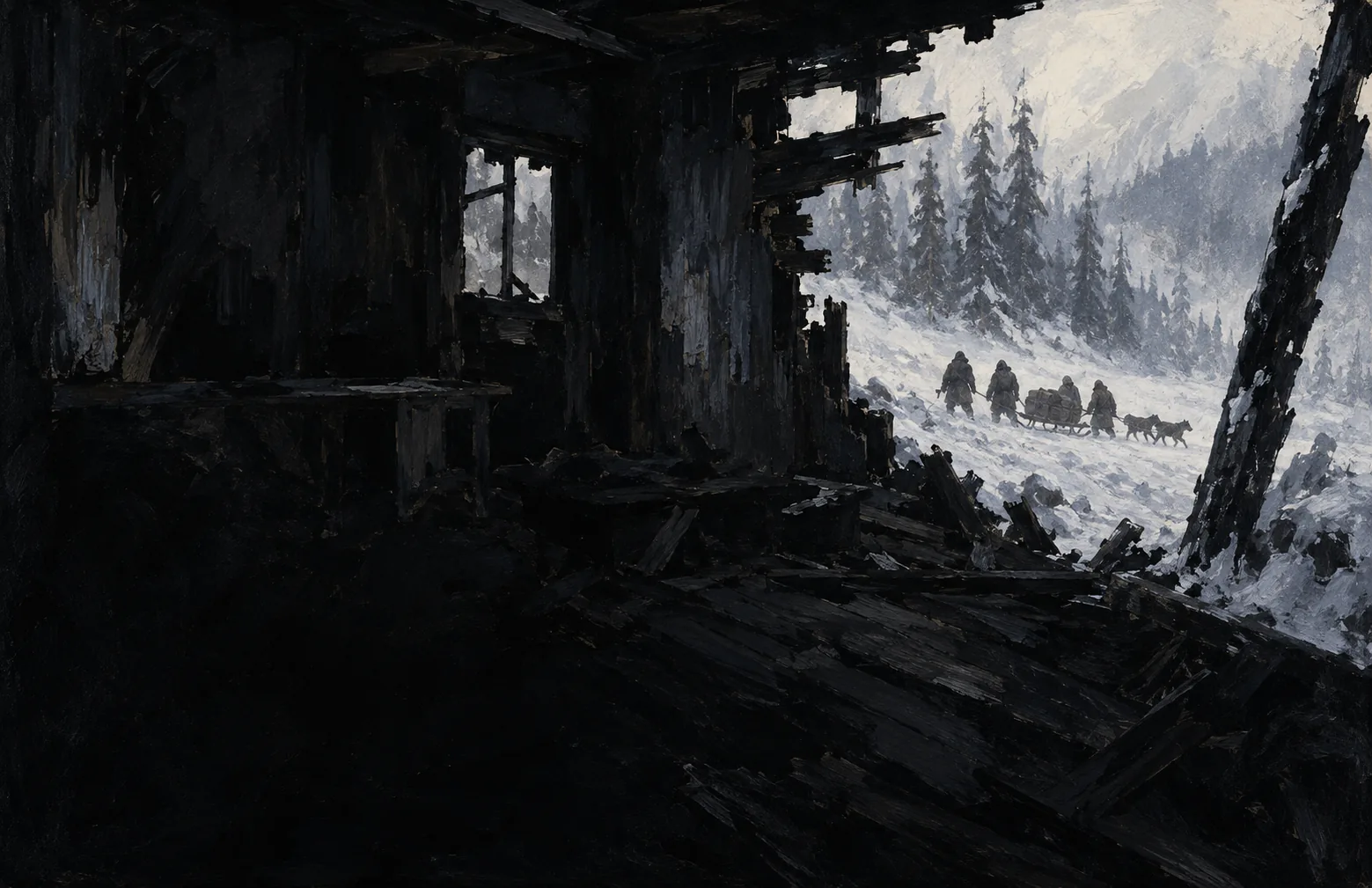
Interior Alaska · January 1911
A winter survival roleplaying game
Forty-three miles. One working wire.
Everyone who walks has to come back into the count.
The storm has already happened
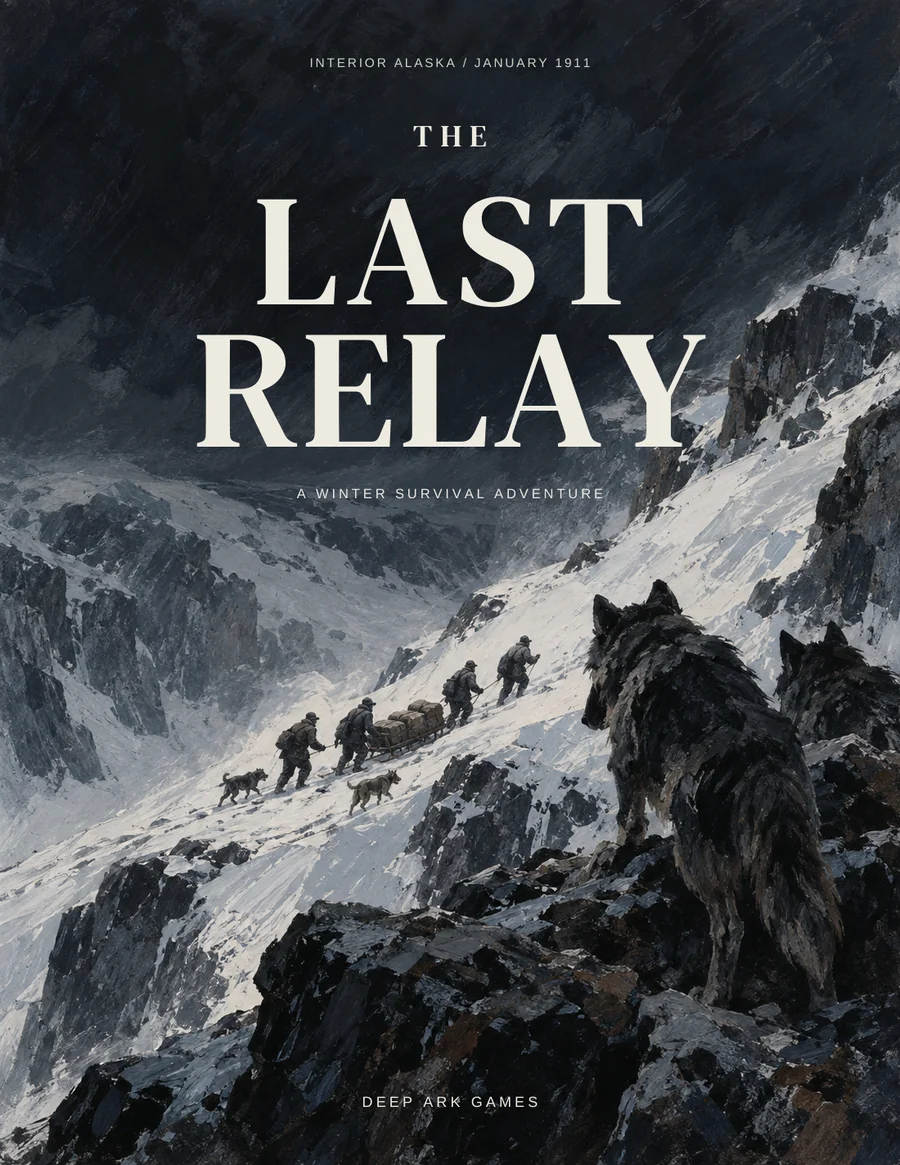
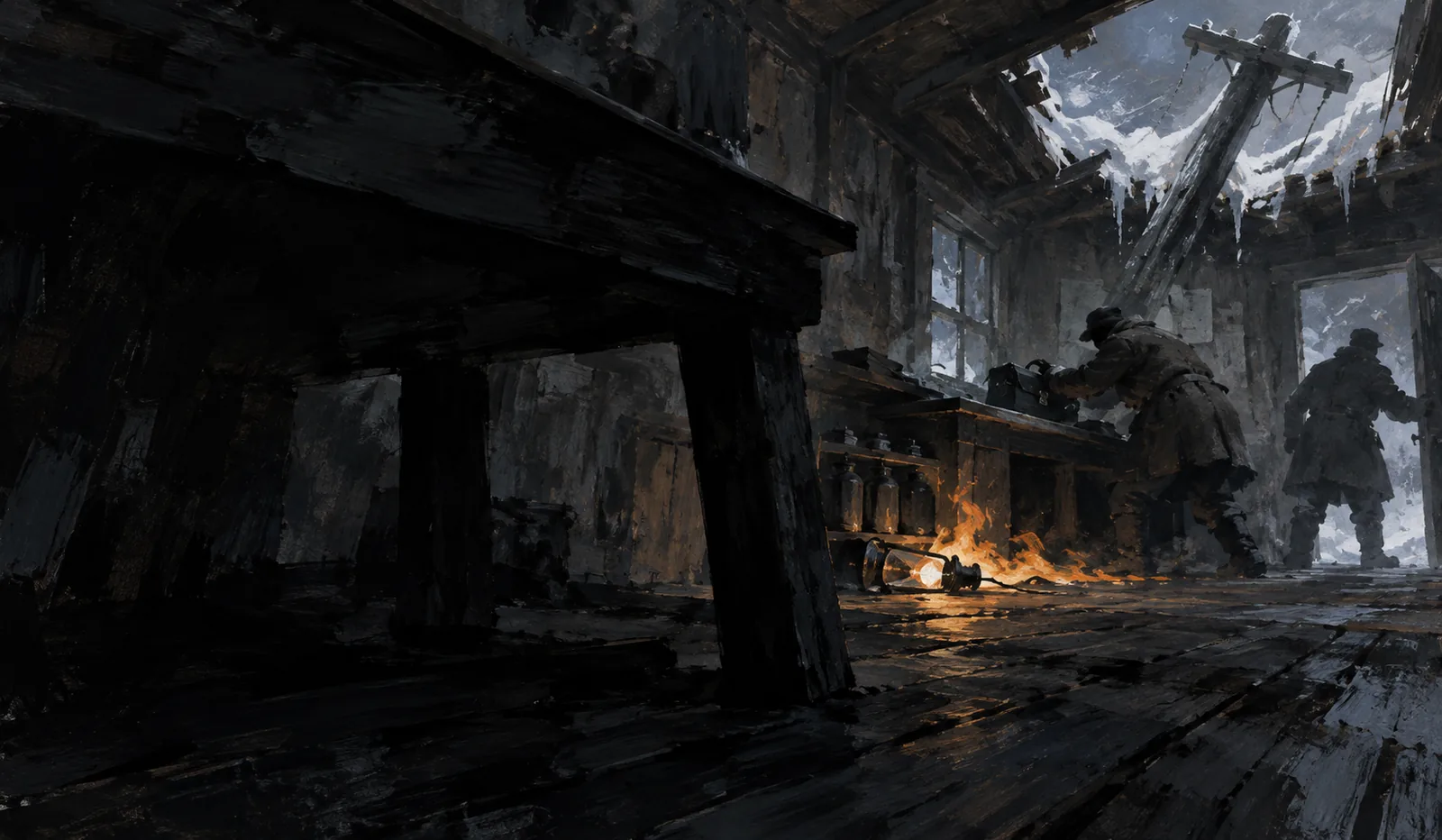
The storm took the roof, the wire and two of the dogs. Alder Fork Relay is forty-three miles east. Eight meals each are on the sled. Somebody has to carry a true report to a working key.
The Last Relay is a tabletop roleplaying game about ordinary working people carrying a message through a winter that does not care about them. One person runs the game. Three to six others play the crew of Rime House, a burned telegraph outpost in a fictional corner of Interior Alaska.
A district superintendent has quietly held back the team that should have come. The players decide who walks, what they carry, who they stop for, what they take from a cache that was left for someone else, and what they finally say when a live telegraph key is under their hands.
What makes it different
Food, dog feed and fuel are tracked in the open, in small honest numbers. Every kindness on the trail is paid for by someone.
Costs are named before the die is rolled. The wolves are animals, not monsters, and they come for whatever the group leaves exposed.
Six workers with beliefs, bonds and a secret they have not said out loud. A secret said at the right moment changes the plan, and the ending notices.
The last scene is a live exchange over the wire with the man who held the team back. What the crew carried decides what they can make him admit.
How to play
Most of the journey needs no dice. Roll only when the outcome is uncertain and failure would cost something real.
Before the die, the table says five things out loud, and the game master never springs a cost nobody named.
| 2 or less | Failure. Pay the named cost. |
|---|---|
| 3–4 | Success with a cost. |
| 5 | Success. |
| 6+ | Success, and you name an advantage. |
Try a roll
±0Desperate. Two or more hazards: a 5 becomes a cost.
Ready when you are.
Set the modifiers, then roll one six-sided die.
A day on the trail
Four dials, all in the open
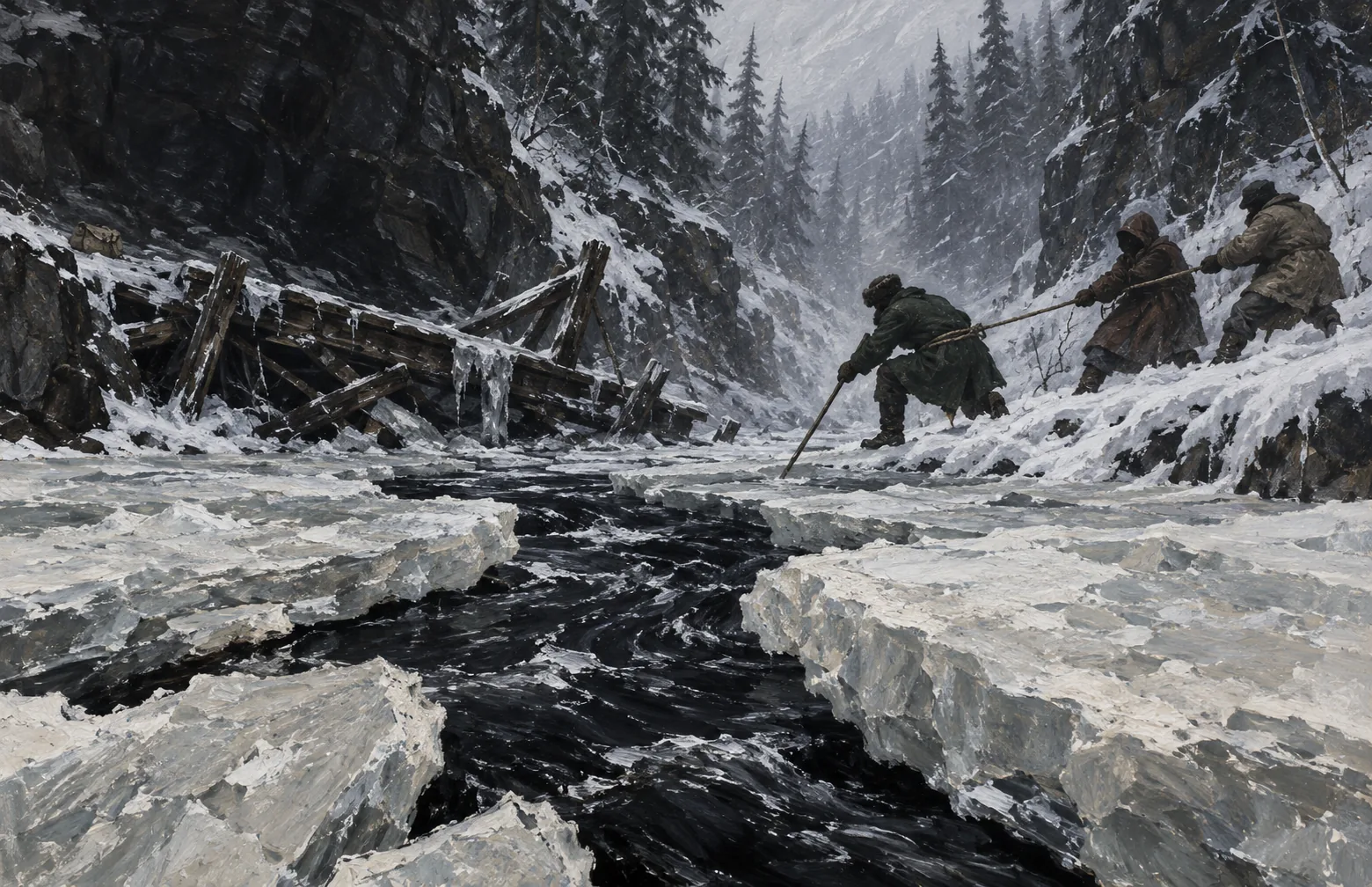
Day 2 · Kettle Narrows
Old ice, new ice, and water moving under the snow. A rope, a probe, and someone willing to share the risk.
The workers of Rime House
Each playbook has two sides. The front is public: a belief to argue for, a bond, a reason of their own to reach Alder Fork, the tool in their hands and one move only they can make. The back is folded over and private.
Forty-six, a scar through her left eyebrow and a brown wool coat she does not lend. A trained mission nurse from Halloway, caught overnight at the wayhouse. She does not work for Northline and nobody at Rime House gives her orders.
Thirty-four, round spectacles, ink worked into his fingers, a gray jacket buttoned to the neck. He keeps the key and the log in one dispatch case and does not set it down.
Twenty-nine, tall, fair hair cropped under a fur cap, a patched green coat, the belt axe always on him. He has walked this line more than anyone alive.
Fifty-two, broad, a rust headscarf, flour worked into her cuffs. She keeps the wayhouse cookhouse that feeds the line crews and the travelers between them. She says the numbers out loud.
Nineteen, lanky, dark curls, a parka still a size too big. Ash walks at his knee. Pebble limps behind.
Forty-one, a reddish beard, a tan coat, a saw scar across the back of his left hand. He assigns the wire watches and signs Northline’s local line-use returns.
Prefer someone else? The book shows how to build your own worker with the same job.
The route
Both routes leave from the far bank of Kettle Narrows and meet again in Blackwater Basin. One has a roof every night. The other is a day shorter and has no roof at all.
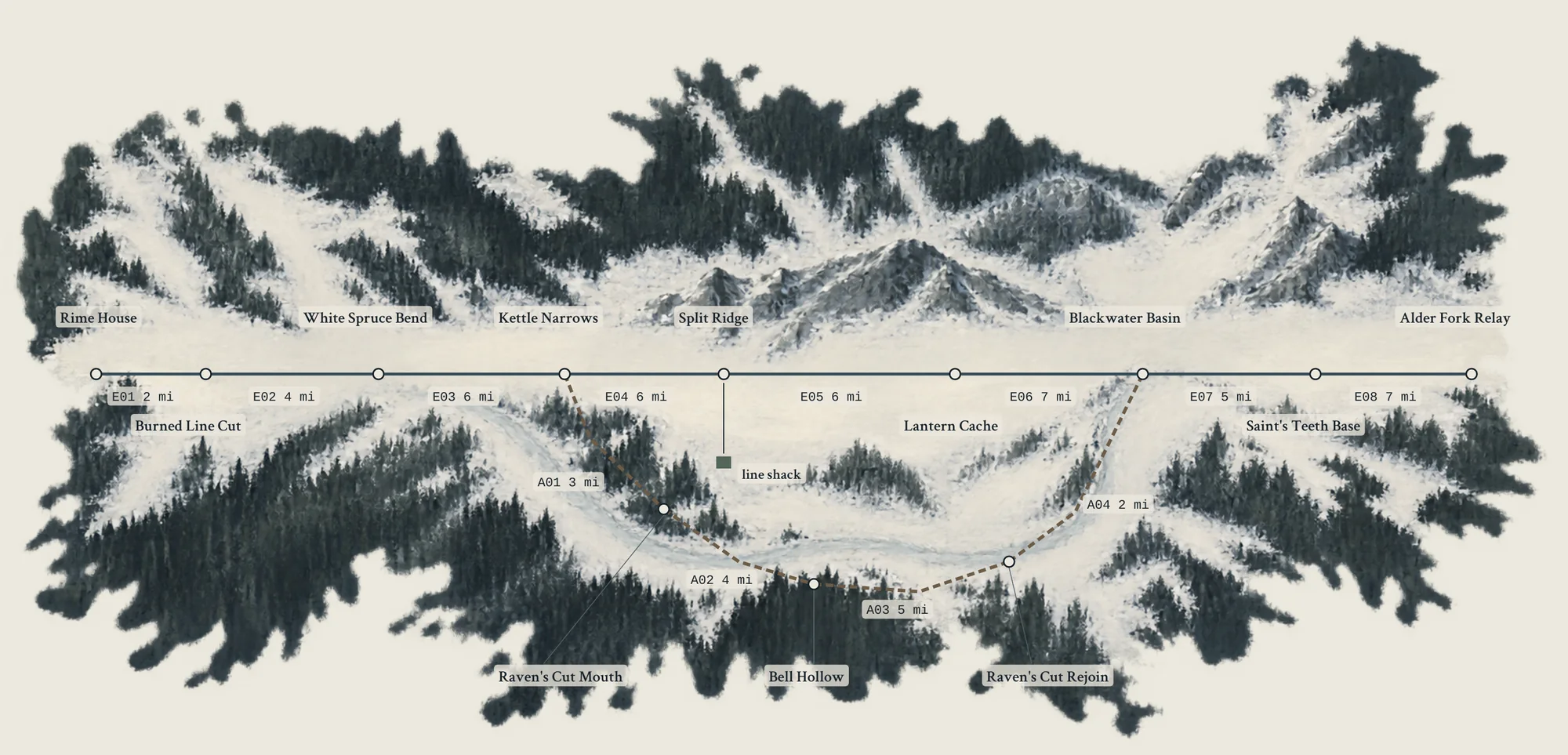
The marked trail
43 mi7 daysShelter most nights
Raven’s Cut
38 mi6 daysNo shelter, no cache
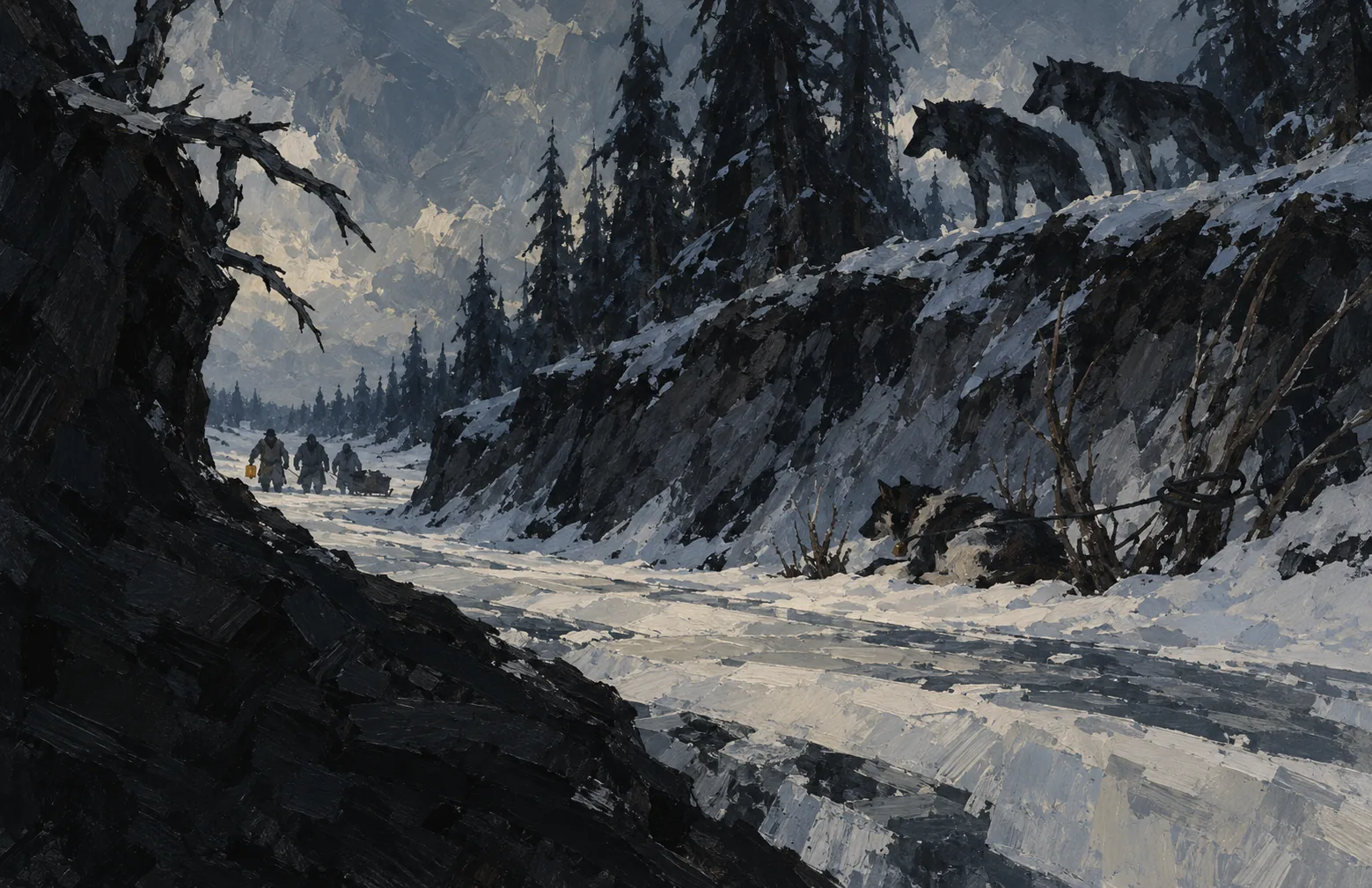
Night 3 · Raven’s Cut
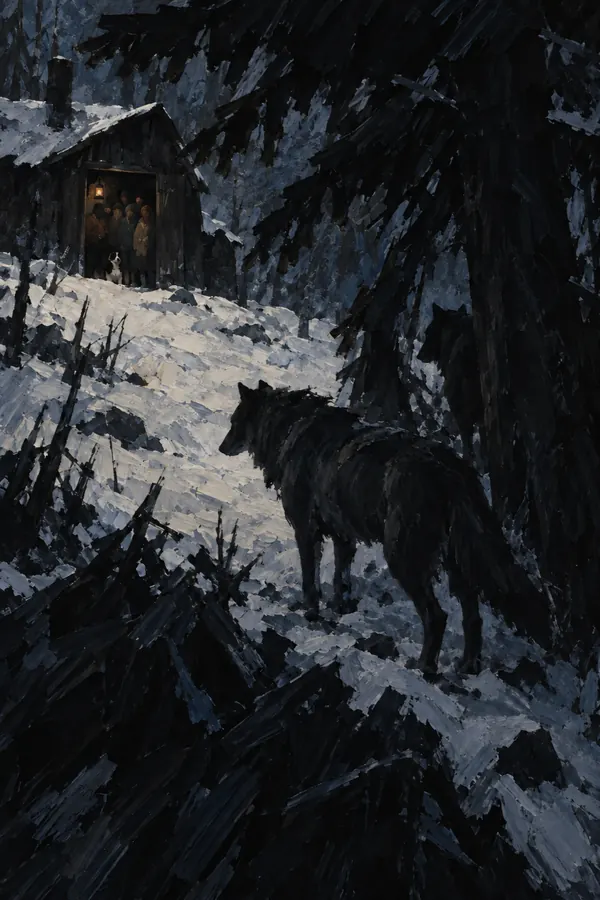
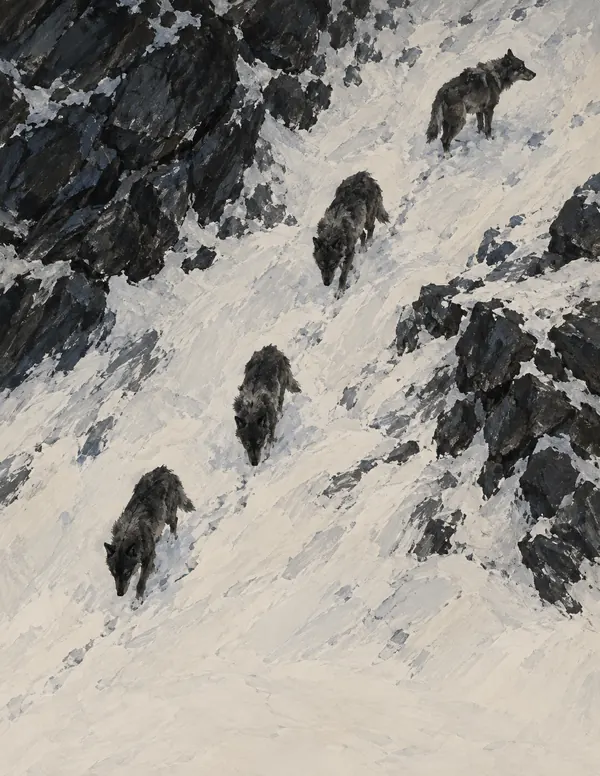
The wolves
You will meet them on the third night, even if you do everything right. Low Wolf Pressure changes what they do, not whether they come.
They stand at the edge of the light long enough to be counted. Stay inside, keep food and blood inside, and they take nothing.
They come in close, for something specific: the feed bag, a dog on its line, the harness left out to dry. Protect it, let it go, or close the camp around it.
They have had too many chances. They come for the most exposed, and someone makes a wolf roll now.
Tight formation, a lantern or fire, a shot, the dogs with Jonah: each is a measure. A group that stays together can turn wolves away without killing them.
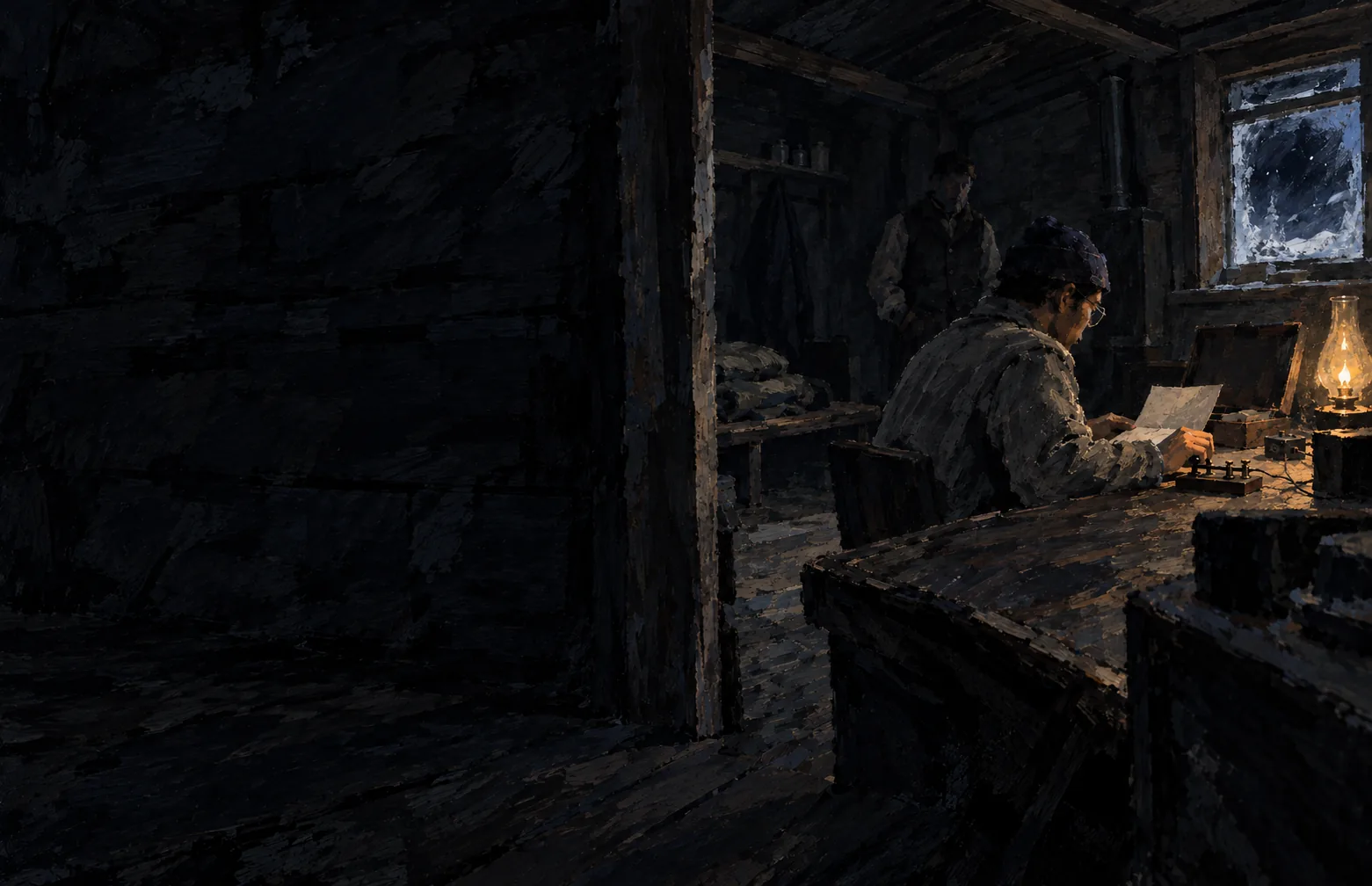
Alder Fork · The climax
The message goes out. Within the hour, the sounder starts again.
The last scene is a live exchange over the wire with the man who held the team back: three exchanges, an acknowledgement, an offer and the pressure. What the crew carried, wrote down and was willing to say becomes Leverage, and Leverage decides what he can be made to admit.
Three ways to play
One evening · about 4 hours
The whole journey as a one-shot for three to five players. Every major choice, none of the walking between them.
For first games, conventions, and groups deciding whether to commit.
3–4 sessions · about 3 hours each
The full journey: both routes, every scene, the basin, the pass and the wire.
The standard game, for three to six players.
4–6 sessions
The storm starts higher, the wolves come one tier harder and a second time, and death no longer needs a named cost.
For experienced tables who want the full weight.
Look inside
Rules, six workers, ten painted maps and every location in the order the trail meets them, with a field reference where every table is already calculated. These are actual spreads from the book.
Coming to Kickstarter
The Last Relay launches on Kickstarter from Deep Ark Games, the studio behind the Black Books. Dates and pricing will be announced when they are confirmed.
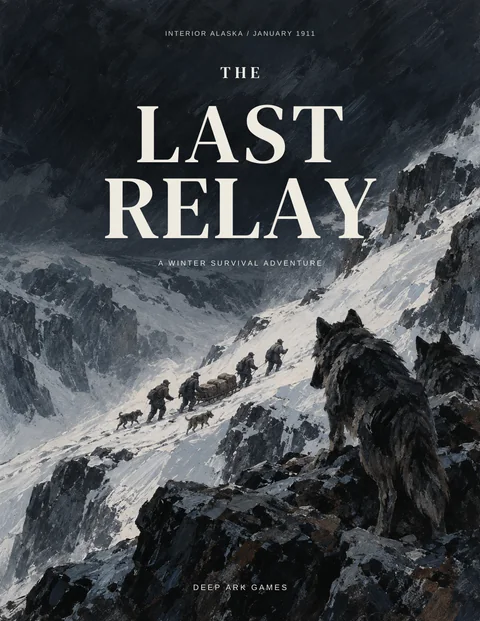
The book
Both routes, the wolves at full strength, the man in the basin and his three ways out, Saint’s Teeth, the live exchange over the wire, seven endings, the one-shot The Crossing, Hard Winter, and a field reference with every table pre-calculated.
Kickstarter tells followers the moment a new campaign goes live.
Questions
The Last Relay is coming to Kickstarter from Deep Ark Games, as a PDF and as a printed book on demand through DriveThruRPG. Dates and pricing will be announced when they are confirmed. Follow Deep Ark Games on Kickstarter to hear when it launches.
No. The Last Relay contains its complete rules. Bring one six-sided die, pencils and the printed Player Packet. One person reads the book and runs the game.
Three to six players and a game master. The Crossing plays in one evening; the standard game runs three to four sessions of about three hours; Hard Winter runs four to six.
Yes. The group can reach Alder Fork. Costs are named before the die is rolled, a group that stays together can turn the wolves away, and care is never earned: a hurt person or dog always gets water, warmth and a real choice.
Cold, hunger, injury, animals hurt or killed, leaving someone behind, and the chance a person dies. The game is non-graphic by default. The Player Packet includes lines and veils, a pause card anyone can touch at any time, and access notes for how each player wants information given.
The route, the company, the workers and the events are invented, set in a fictional corner of Interior Alaska in January 1911. The winter labor, shelters and stopping places draw on Hudson Stuck’s Ten Thousand Miles with a Dog Sled (1914), and the book explains how it uses that account and its limits. No particular real community is portrayed.
This second edition was rebuilt after a full review of the first: new result bands, the Wolf Pressure ladder, Raven’s Cut as a real route and the exchange over the wire. Human playtests at new and experienced tables come next, followed by a printed proof before print-on-demand opens.
The paintings were generated with OpenAI’s image tools, selected under the creator’s art direction, and placed in the layouts as generated, without repainting. The page spreads on this site come from the book itself.